Imagine collecting articles that mention a database founder. Some concern database systems, some concern enterprise sales, and some concern unrelated activities. Each article can be measured on the same fixed news directions. The collection then has a mathematical shape: it spends more of its coverage in some directions than in others.
That is the sense in which a person becomes a source of news. It is a distribution of associated reporting. It does not mean the person wrote, approved, or caused the articles. Nor is the resulting vector a psychological portrait. Change the corpus (the article collection), the dates, or the attribution rules and the profile can change.
Three objects must remain separate throughout the calculation. An identity says which person a record denotes. An article association says that a particular article is a candidate match to that person. A relationship assertion says something specific, such as that one person reported to another during a stated period, with a source for the claim. A reliable identity does not automatically make every name match reliable. Two people appearing in an article does not establish a relationship between them.
The vector model starts from qualified candidate article associations. Anthropology’s graph stores separately sourced assertions and explicitly marked co-mentions. The same interface can display both, but one is not evidence for the other. A short distance in the vector view means similar coverage under that model. A line labeled employment in the graph needs employment evidence.
There will also be two meanings of people vector. A person profile describes one individual. A people pattern is a direction learned from the variation among many profiles. Think of the difference between a city’s weather measurements and a recurring weather pattern. A city has coordinates on the pattern; it is not itself the pattern.
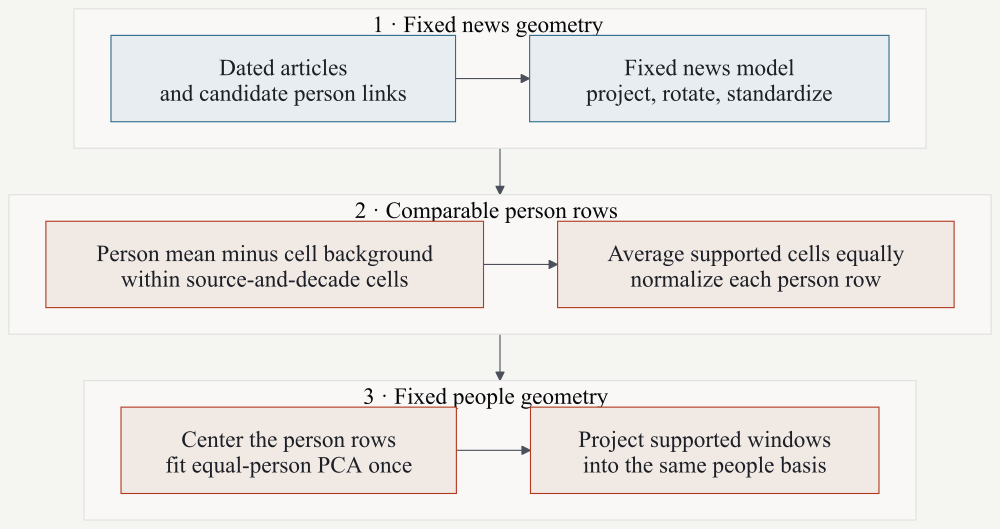
The diagram is a roadmap of operations explained below. Project means measure along selected directions; rotate means change their orientation; standardize means divide by reference standard deviations. Center means subtract a comparison mean, and normalize means divide a nonzero row by its length. Principal component analysis (PCA) finds directions of greatest variation among centered observations. These names label the stages, not additional assumptions about a person’s identity.
The book follows this path in the order shown before explaining how the middle can be explored in both directions. At each step we will ask what the numbers mean and what information the operation discards.
Check 1. An article names two people. How many unique articles should it contribute to a background average, and how many person-article associations might it contribute? Keep your answer for the solutions at the end.