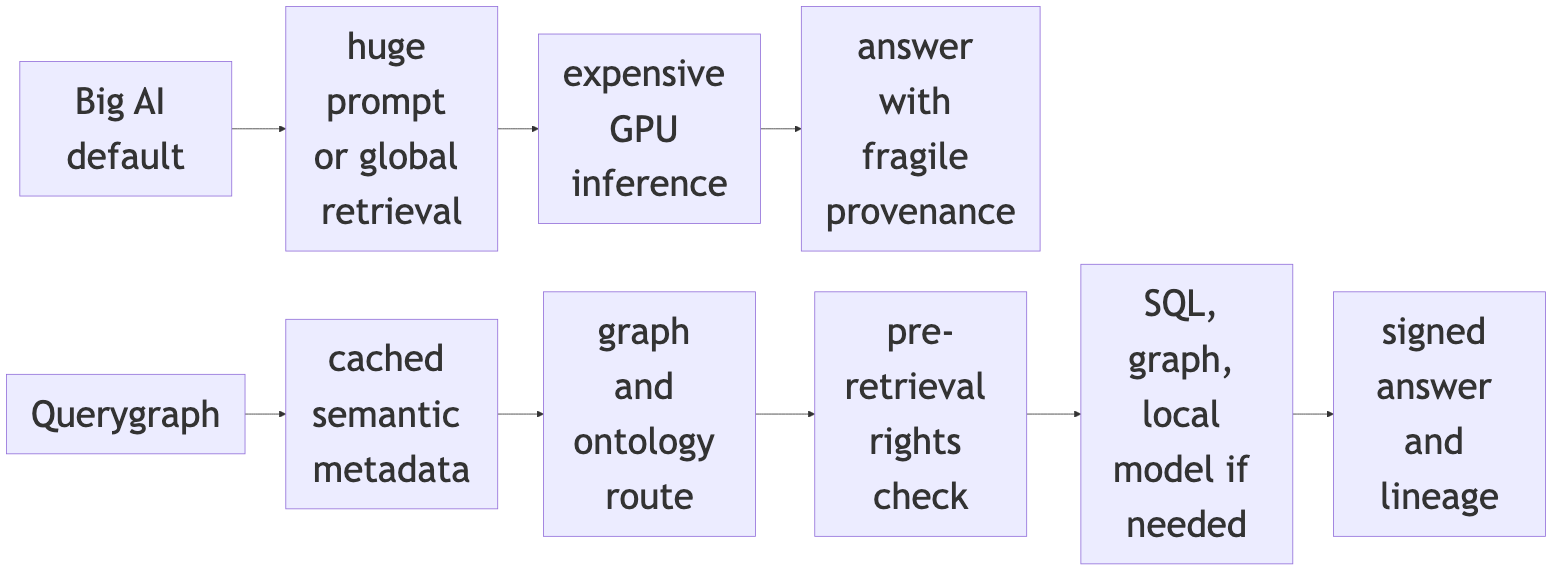
Querygraph is not anti-model. It is anti-waste, anti-ambiguity, and anti-ungoverned computation. The difference matters. A model can be powerful and still be the wrong place to solve every part of the problem.
Big AI often asks organizations to centralize data, trust opaque retrieval, expand context windows, and pay for repeated GPU inference. Querygraph asks a different question: how much of the work can be made precise, cached, local, typed, governed, and reproducible before a model is called?
The answer is: a lot.
Semantic Croissant can describe files and fields without a model. CDIF can publish discovery and access metadata without a model. OSI can define business terms without a model. ODRL can deny unauthorized access without a model. Grust can traverse the route from question to concept to field without a model. Sail can execute SQL without a model. OpenLineage can record the run without a model. DIDs and TypeSec can identify and bound agents without a model.
When all of that work is done first, the model receives a smaller and more meaningful task. It summarizes. It drafts. It explains. It may help resolve an ambiguous phrase. It does not have to impersonate the entire data platform.
This is the proof of the alternative:
Querygraph therefore competes with Big AI not by claiming that smaller models are always smarter, but by changing the unit of intelligence. Intelligence is not only in the model weights. It is in the route, the metadata, the policy, the graph, the lineage, the cache, and the disciplined refusal to compute over what the agent should never have seen.
That is why the AI Navigator matters. It makes precision cheaper than guesswork.