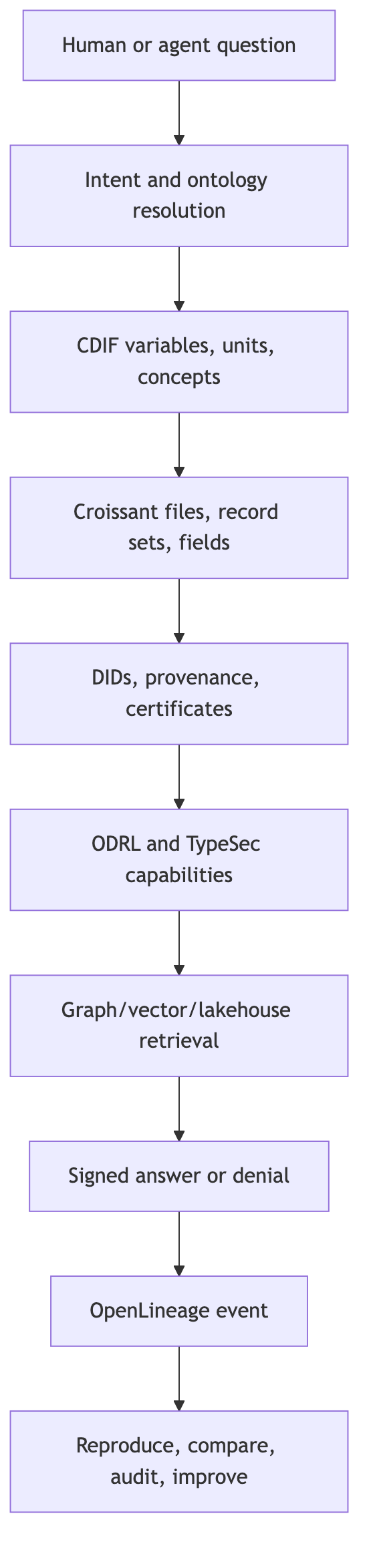
The public QueryGraph.ai posts describe a larger ambition than a metadata library. They describe an AI Navigator: a system that lets agents move through data with the same precision that a navigation system gives to physical travel. The navigator does not merely retrieve documents. It finds the right semantic object, checks whether the agent is allowed to use it, records the provenance of every step, and makes the resulting answer reproducible.
The motivation begins with a critique of contemporary LLM systems. They are fluent but unstable. The same prompt can drift across time, model version, provider, and context window. For casual chat this may be charming. For science, policy, medicine, finance, infrastructure, and enterprise operations, it is a control failure. A reliable AI system needs context, provenance, and governance before it needs more tokens.
The deeper critique is computational. Big AI often treats ambiguity by scaling up: bigger models, larger context windows, more embeddings, more GPU cycles, more remote inference, more global search. Querygraph takes the opposite bet: the best way to make AI useful is to reduce the problem before inference. Resolve the ontology. Find the exact dataset. Select the permitted fields. Reuse cached semantic descriptions. Retrieve the smallest responsible context. Then call a local or governed model only when the model is actually needed.
The posts make several claims that become design principles in Querygraph:
In this vision, an AI Navigator is not a chatbot. It is the semantic operating layer for agentic AI.
One QueryGraph.ai theme is compression: a system understands something only when it can reduce noise to a portable, structured signal. Querygraph applies that idea to enterprise data. A raw table with 800 columns is not yet knowledge. A table described by Croissant, grounded in CDIF variables, linked to ontology terms, governed by ODRL, and indexed in a graph has been compressed into a form an agent can safely use.
Example: an energy survey may contain a column that looks like a number. The compressed semantic signal says what the number means, what unit it uses, which geography it belongs to, which survey instrument produced it, whether a given agent may summarize it, and what redaction rule applies before sharing.
Another theme is vector stabilization and temporal ground truth. Querygraph does not claim that all knowledge is timeless. It assumes the opposite: knowledge changes, models drift, policies change, and experts disagree. The task is to record the time, source, authority, model, prompt, and data state behind an answer so later agents can compare one answer to another.
Example: a climate-health briefing generated on June 14, 2026 should be replayable against the same lakehouse manifest, Croissant/CDIF sidecars, TypeDID envelopes, OpenLineage event, and DID attestation hash. If the answer changes after a model upgrade or a dataset correction, Querygraph should show what changed.
The QueryGraph.ai data-infrastructure post argues that responsible AI needs context, provenance, and governance. Querygraph maps those directly:
Example: an agent asks for a mobility-risk prediction. Querygraph does not hand it every transportation table. It resolves the question to a mobility compartment, identifies dockless-transportation and pedestrian-injury tables, checks whether the agent may derive a summary, records the run, and returns only a signed summary.
The Palefire posts point toward graph-plus-vector navigation. Querygraph’s current Rust implementation emphasizes the graph and lakehouse side, but the architecture leaves room for vector stores. The graph identifies things: datasets, variables, policies, agents, claims, prompts, and lineage events. Vectors help discover similar things: related papers, near-synonymous terms, translation candidates, or concept clusters.
Example: a user asks about “energy burden.” A vector search may find related phrases such as “energy insecurity” or “access to clean cooking.” The graph then decides which are official terms, which datasets contain them, what ontology defines them, and what policies govern them.
The AgStack post matters because it shows the same pattern outside a single company. Agriculture, climate, health, food security, and geospatial identity all need shared infrastructure. Querygraph’s lakehouse example is enterprise shaped, but the architecture works for public infrastructure too:
Example: a regional food-security agent could combine weather, crop, soil, market, and logistics data. It should know which datasets are public, which are licensed, which are embargoed, and which are local to a cooperative.
The strongest version of Querygraph is ontology-driven precise AI. It is not satisfied with “probably relevant chunks.” It wants the exact concept, the exact variable, the exact unit, the exact source, and the exact permission.
Precision does not mean rigidity. The navigator can still use LLMs, embeddings, and agents. But those systems operate inside a semantic frame:

This is the opposite of a giant ungoverned context window. It is a precise navigation path through meaning, authority, and permitted action.
Querygraph is local-first by design. Local-first does not mean isolated or small-minded. It means the organization keeps its data, metadata, policies, lineage, and agent traces inspectable on infrastructure it can understand. Open-source systems matter here because responsible AI is not only a model property. It is an operational property. If the routing, retrieval, policy, identity, and audit layers are opaque, the system cannot be fully governed.
The practical target is not “never use GPUs” or “never call a frontier model.” The target is to avoid making expensive global inference the default path for questions that can be answered by precise retrieval, graph traversal, cached semantic metadata, SQL, and compact local model calls. Querygraph tries to move as much work as possible into stable, CPU-friendly infrastructure:
This is the AI Navigator thesis: a well-built semantic route is cheaper, safer, and more reproducible than a giant prompt.
This vision section synthesizes the QueryGraph.ai posts on CODATA, Semantic Croissant, responsible AI infrastructure, vector stabilization, compression, Palefire, and AgStack: