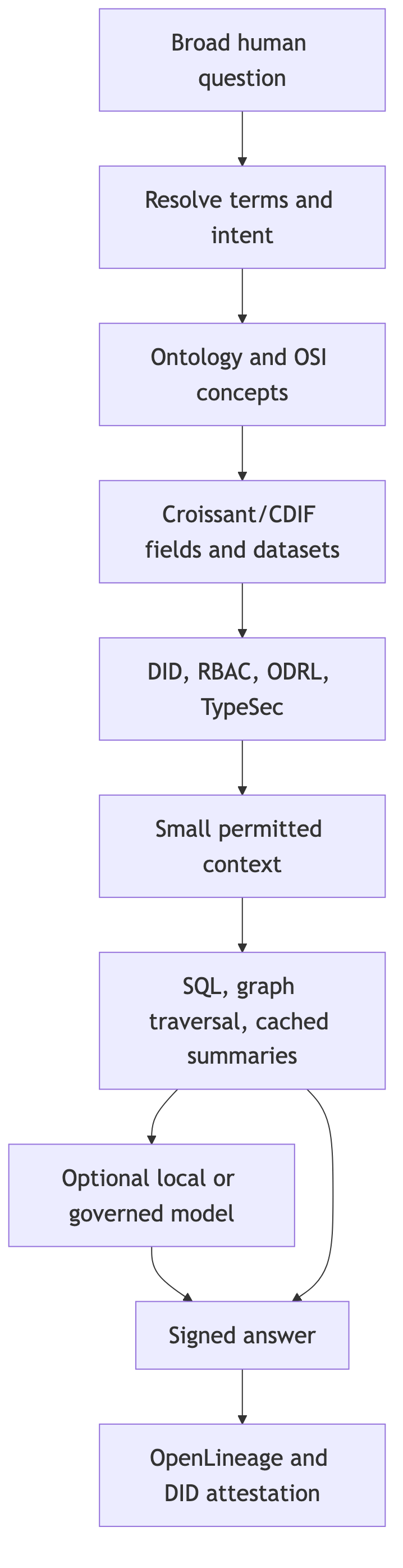
The four components underneath the semantic layer: the graph and its query language, the security fabric and its identity machinery, the catalog and its handoff, and the compute engine. Each chapter explains its component from scratch and ends with worked examples.
Grust is a modern property-graph API for Rust with a deliberately plain core model:
Graph = nodes + edges
Node = id + label + properties
Edge = optional id + from + to + label + properties
That shape is expressive enough for persistent graph databases but
small enough for tests, import/export tools, scrapers, and
knowledge-graph pipelines. The design principle is strict separation of
concerns: application code builds a grust::Graph; backend
crates decide how to persist or query it. Grust is not competing with
petgraph for in-memory graph algorithms — it is the
persistent property-graph layer: stable application IDs, node
and edge labels, typed properties, optional schema metadata, traversal
expressed as an IR rather than a query string, and an async
GraphStore trait for persistence backends.
The workspace ships a facade crate (grust-graph,
imported as grust) over a core (model, builder, schema
validation, traversal IR, GraphStore) and a family of
backends:
| Backend crate | Target |
|---|---|
grust-memory |
deterministic in-memory store for tests and local use |
grust-sail |
Sail SparkConnect — graphs as Spark DataFrames (QueryGraph’s choice) |
grust-turso |
embedded Turso/SQLite storage (LakeCat’s choice) |
grust-postgres, -postgres-pgq,
-pggraph |
PostgreSQL: universal tables, SQL/PGQ, pgGraph |
grust-surreal, grust-helix,
grust-falkor, grust-ladybug,
grust-lancedb |
SurrealDB, HelixDB, FalkorDB, LadybugDB, LanceDB |
grust-cocoindex |
CocoIndex-style target-state export |
The builder deduplicates nodes by id and, by default, edges by
(from, label, to); domains that need multi-edges opt into
EdgePolicy::AllowDuplicates. Typed property schemas
validate graphs before they reach a store.
QueryGraph uses Grust twice. First, the semantic graph — datasets, fields, ontology terms, agents, policies, as nodes and edges — loads into a Grust store. Second, the Sail fork compiles a Cypher extension into the engine (Chapter 7), reusing Grust’s model, so the same graph is queryable from Spark sessions.
use grust::prelude::*;
let mut builder = GraphBuilder::new();
let dataset = builder
.node("Dataset", "dataset:county-finance")
.prop("source", "sail.qg_lakehouse.government_finance__countydata")
.finish();
let metric = builder
.node("Metric", "metric:fiscal-capacity")
.prop("expression", "SUM(total_revenue - mandated_spend)")
.finish();
builder.edge("MEASURED_OVER", &metric, &dataset).finish();
let graph = builder.build();
// Persist and traverse (memory store; SailGraphStore is the same trait).
let store = MemoryGraphStore::new();
store.put_graph(&graph).await?;
let datasets = store
.traverse(
Traversal::from_node("metric:fiscal-capacity")
.out("MEASURED_OVER")
.to("Dataset"),
)
.await?;
assert_eq!(datasets.len(), 1);The traversal is an IR, not a string: the same Traversal
runs against memory, PostgreSQL, or Sail, each backend lowering it
natively.
| Surface | Essentials |
|---|---|
GraphBuilder |
new(),
.node(label, id).prop(k, v).finish(),
.edge(label, &from, &to).prop(k, v).finish(),
.edge_policy(EdgePolicy::AllowDuplicates),
.build() -> Graph |
Graph / Node / Edge |
plain data: ids, labels, typed property maps; serde-serializable |
Traversal |
from_node(id).out(label).to(label) — an IR, lowered
natively per backend |
GraphStore (async trait) |
put_node, put_edge,
put_graph, get_node,
traverse |
| Stores | MemoryGraphStore::new(); SailGraphStore
(Spark Connect); grust-turso,
grust-postgres{,-pgq}, grust-surreal,
grust-helix, grust-falkor,
grust-ladybug, grust-lancedb |
| Schema | optional typed property schemas; graphs validate before reaching a store |
Crab (0.11) gave the graph a language: a standards-conformant
GQL/Cypher layer — lexer, parser, AST, semantic analysis — over the
property graph, with read pushdown into Sail and SQLite, first-class
Decimal/Duration/temporal values, and catalog procedures such as
CALL db.labels().
Lobster (0.12) completes it. The merged Full39075 profile brings:
CALL { … } subqueries;CALL with correlated
arguments);shortestPath() / allShortestPaths() on the
read reference;CypherTransaction accumulates eagerly-planned write
statements between START TRANSACTION/BEGIN and
commit, executing them atomically behind the transaction surface.Reads are portable: grust-cypher::read::run_read_query
executes Cypher against any grust::Graph with a reference
executor, while stores like SailGraphStore push the
identical query down to the backend. Writable Cypher is a strict,
backend-neutral mutation plan (cypher_mutation_plan) that
stores execute natively.
Exactly how qg-rust queries its semantic graph
(src/cypher.rs):
use grust_cypher::read::run_read_query;
use grust_cypher::CypherParameters;
let table = run_read_query(
&graph,
"MATCH (m:Metric)-[:MEASURED_OVER]->(d:Dataset) \
RETURN m.expression, d.source",
&CypherParameters::new(),
)?;Through the Sail fork’s extension (Chapter 7), the same
MATCH also runs from any Spark Connect session — PySpark
included — against the graph the lakehouse projects.
| Surface | Essentials |
|---|---|
grust_cypher::read::run_read_query(&graph, cypher, ¶ms) |
portable reference executor over any grust::Graph;
returns CypherResultTable |
CypherParameters |
new(), typed parameter binding |
cypher_mutation_plan(cypher) /
sail_cypher_mutation_plan |
strict backend-neutral write plans |
SailGraphStore::run_read_query /
execute_cypher_mutation* |
backend pushdown; _returning_with_options returns
generated ids |
CypherTransaction |
accumulates eagerly-planned writes between
BEGIN/START TRANSACTION and commit; atomic
execution |
CypherSession / SessionCommand |
standalone USE and session commands |
| Catalog procedures | CALL db.labels() and friends, over the projected
graph |
TypeSec encodes permissions as types. Most security systems check permissions at runtime — and a guard-based check can be forgotten, skipped, or bypassed:
// ❌ Guard-based — one missed call and the policy is fiction.
if acl.check(user, "write", resource) {
resource.write(data);
}TypeSec inverts this. If your code does not hold a
Capability<CanWrite, Report>, the write method
does not exist for you:
// ✅ Type-level — the capability IS the proof.
fn write(cap: Capability<CanWrite, Report>, report: &Report) {
// `cap` existing in scope means the policy engine approved this.
}The Capability<P, R> struct is unforgeable by
construction:
pub(crate) — only the policy engine
creates one;P and R are phantom types —
Capability<CanRead, Report> and
Capability<CanWrite, Report> are different
types;Permission trait is sealed — no new permissions
outside typesec-core.The only production path to a capability runs a policy check and emits an audit event; a denial is a typed error carrying a receipt, never a capability. Policy violations are compile errors, not incident reports.
QueryGraph’s supervised agent story (Part II, Chapter 16) mints
capabilities for exactly the actions its topology needs:
AiCanInfer, CanReadSensitive,
CanDelegate, CanAggregateSummaries,
CanReadDatasetCompartment, and
CanDeriveRedactedSummary.
use typesec::prelude::*;
// Without a Capability<CanRead, Report> in hand, this function
// cannot be called — the check is the type system's, not yours.
fn read_report(cap: Capability<CanRead, Report>, report: &Report) -> Summary {
summarize(report) // `cap` in scope == the policy engine said yes
}
let decision = engine.check(&subject, Action::Read, &report);
match decision {
Ok(cap) => read_report(cap, &report), // audit event already emitted
Err(denied) => return Err(denied.receipt()) // a denial is data, not panic
};| Surface | Essentials |
|---|---|
Capability<P, R> |
unforgeable proof; pub(crate) constructor; phantom
permission/resource types |
Permission (sealed) |
e.g. CanRead, CanWrite; QueryGraph adds
domain permissions (AiCanInfer,
CanReadSensitive, CanDelegate,
CanAggregateSummaries,
CanReadDatasetCompartment,
CanDeriveRedactedSummary) |
PolicyEngine::check(subject, action, resource) |
Ok(Capability) — audit event emitted — or
Err(Denied) with a receipt |
Capability::<P, R>::permission_name() |
stable permission strings for evidence reports |
| Policy engines | RBAC, ODRL, and graph policy backends behind one
check |
On top of the capability core, TypeSec provides the machinery QueryGraph uses for agent identity and messaging:
Ed25519DidKey::from_seed derives a keypair from a seed
(SHA-256 of the seed as the private key), so an agent recreated from the
same seed signs identically across processes — and, as QueryGraph
proves, across languages.did:key documents: public keys
published as W3C DID identifiers anyone can resolve without a
registry.ed25519-x25519-chacha20 profile, with a request/reply
conversation model (the typedid/a2a protocol label — made
literal by QueryGraph’s A2A card, Part III).Torcello (0.12) grows this fabric into a platform other agent stacks
plug into: an agent-framework interop plane guarding
OpenAI, Anthropic, LangChain, and Pydantic-AI tool calls; an MCP dialect
and mcp-gate, a deny-by-default MCP stdio
proxy; signed decision receipts with decision logging
and replay; JSON-Schema-validated tool bindings and a
#[typesec_tool] macro; an OpenTelemetry audit sink; a WASM
decision core for JS/TS agents; a PyPI-ready Python package; and an
OpenAI/Anthropic-compatible enforcement proxy — the
“governed inference proxy” pattern, built at the security layer.
QueryGraph already builds against Torcello; adopting these surfaces
rather than duplicating them is the next integration step (see Future
Work).
Python signs:
from querygraph.typedid import TypeDidAgent
supervisor = TypeDidAgent.new("SupervisorAgent")
envelope = supervisor.request(
TypeDidAgent.new("FinanceAgent"),
action="summarize", resource="compartment:finance",
payload={"question": "Where is fiscal stress highest?"},
)
print(envelope.signature[:24]) # ed25519:8a7a231b6f67f4…
print(envelope.verification_method[:32]) # did:key:z6Mkrdhpo…Rust mints the identical identity from the identical seed:
use querygraph::agent::PyTypeDidEnvelope;
let envelope = PyTypeDidEnvelope::signed(
"querygraph-agent:SupervisorAgent", // same seed ⇒ same did:key
"did:example:recipient",
"summarize", "compartment:finance",
serde_json::json!({"question": "Where is fiscal stress highest?"}),
);
assert!(envelope.verify().signature_valid);A fixture test pins the shared did:key, so the
derivations can never drift.
| Surface | Essentials |
|---|---|
Ed25519DidKey::from_seed(bytes) |
deterministic keypair — sha256(seed) as private key |
Did::key(signing_public) |
did:key:z6Mk… identifier |
TypeDidProfile::ed25519_x25519_chacha20() |
the negotiated envelope profile |
A2aTypeDidAdapter::wrap(TypeDidWrapRequest, resolver, key_store) |
sign + encrypt a payload into an envelope |
TypeDidGateway::open_message(&envelope) |
verify + decrypt; yields VerifiedTypeDidMessage |
VerifiedTypeDidMessage::attestation() |
audit-safe: action, resource, privacy, profile, envelope digest |
| Torcello surfaces | interop plane (OpenAI/Anthropic/LangChain/Pydantic-AI guards),
mcp-gate, signed decision receipts + replay,
#[typesec_tool], OTel sink, WASM core, enforcement proxy,
PyPI typesec |
LakeCat is a Rust-native Apache Iceberg REST catalog and QueryGraph
foundation. Standard Iceberg clients speak to it on ordinary REST
catalog paths (/catalog/v1); underneath, it binds catalog
state, governed Sail planning, TypeSec receipts, and Grust projection to
the same accepted table transition, so the catalog’s view of a
table and the governance evidence about it can never drift apart.
The catalog spine runs on Turso MVCC: commits to different tables run truly concurrently, and a same-table race converges to exactly one winner through a pointer compare-and-swap — no global write lock. The audit event, the lineage outbox row, and the idempotency record are written in the same transaction as the table change, which is what lets a downstream consumer accept catalog state as proof rather than as a best-effort side effect.
Scan planning routes through the Sail-facing engine: point-in-time scans produce opaque Iceberg REST plan-task tokens from stable Sail metadata; append-only incremental scans over a snapshot chain plan only the manifests added in the requested range, expanding delete manifests through Sail’s delete-file index. REST scan filters are validated against Sail’s generated Iceberg expression models before planning.
Ocelot (0.3.0) proves the boundary from the stock client’s side:
Iceberg REST conformance demonstrated by a PyIceberg
round-trip — spec-correct error types (403 on authorization
denial, 409 on a duplicate namespace, 404 on a missing one),
listTables, honest update rejection on the default build,
and fail-closed commit-requirement validation — over dependencies moved
to Grust “Lobster” and TypeSec “Torcello”. The release rests on a
recorded release-candidate proof harness (Chapter 6’s handoff, verified
end to end, 40/40 QueryGraph tests green).
| Surface | Essentials |
|---|---|
GET /catalog/v1/config |
standard Iceberg REST config — stock clients start here |
/catalog/v1/namespaces… |
namespace CRUD, listTables, table load/commit —
Iceberg-spec error model (403/404/409 with spec type
strings) |
| Scan planning | point-in-time and append-only incremental plans as opaque plan-task tokens from stable Sail metadata; filters validated against generated Iceberg expression models |
GET /querygraph/v1/bootstrap |
the bootstrap bundle: Croissant, CDIF, OSI, ODRL, OpenLineage, Grust-ready graph envelope |
lakecat-cli |
config --catalog URL and friends |
| Feature flags | sail-local, typesec-local,
grust-turso-local, turso-local compose the
local integration set |
LakeCat’s signature surface for QueryGraph is the bootstrap
bundle at /querygraph/v1/bootstrap: a projection
of live catalog tables into Croissant, CDIF, OSI, ODRL, OpenLineage, and
a Grust-ready graph envelope.
The wire format and its verification live in a small shared crate,
qglake-bundle, used by both producer and consumer. qg-rust
does not keep a hand-written copy of those types: it deserializes the
canonical QueryGraphBootstrap, runs LakeCat’s own
verify_manifest, and layers its Cypher import plan on top.
The bundle cannot mean two slightly different things on the two sides of
the boundary.
# Terminal 1: the catalog, with Sail planning, TypeSec receipts,
# and Grust projection bound to table transitions.
LAKECAT_BIND_ADDR=127.0.0.1:8181 \
LAKECAT_TURSO_PATH=target/local/catalog.turso \
LAKECAT_GRUST_TURSO_PATH=target/local/catalog-graph.turso \
cargo run -p lakecat-service \
--features sail-local,typesec-local,grust-turso-local,turso-local
# Terminal 2: standard Iceberg clients see an ordinary REST catalog…
cargo run -p lakecat-cli -- config --catalog http://127.0.0.1:8181
# …and QueryGraph sees live tables projected into Croissant, CDIF,
# OSI, ODRL, OpenLineage, and a Grust-ready graph envelope.
curl -s http://127.0.0.1:8181/querygraph/v1/bootstrap > bootstrap.json
# qg-rust verifies the bundle with LakeCat's own shared wire crate
# (qglake-bundle) and emits its import plan:
cargo run -- lakecat-import --bundle bootstrap.json --output import-plan.jsonThe import command prints the bundle’s verification report; QueryGraph accepts catalog state as proof.
| Surface | Essentials |
|---|---|
qglake-bundle crate |
the shared wire format: QueryGraphBootstrap and its
verify_manifest |
LakeCatBootstrapBundle::from_path(path) (qg-rust) |
parse a bundle file |
.import_plan() |
verification report + the Cypher import plan QueryGraph executes |
| CLI | querygraph lakecat-verify --bundle … ·
querygraph lakecat-import --bundle … --output plan.json |
Sail is the Spark-compatible lakehouse engine (from lakehq) that
QueryGraph uses as its compute and storage substrate: typed Parquet
tables registered in a Spark Connect-compatible server, queryable from
PySpark, with the QueryGraph audit trail (qg_audit) living
alongside the data it audits.
The stack’s fork (branch grust) adds a Cypher
graph-query extension compiled into Sail itself — roughly 5,600
lines across twenty files: a Cypher AST in sail-sql-parser,
graph analysis in sail-sql-analyzer, and plan resolution in
sail-plan, with Spark Connect integration and a design
document (docs/development/graph-extension.md). Crucially,
it reuses Grust’s property-graph model and schema validation rather than
reimplementing them.
The consequence: the same semantic graph that QueryGraph loads
through Grust is MATCH-able from any Spark Connect session
— no separate graph database in the deployment, no second copy of the
graph to drift.
# From PySpark, against the Sail server the lakehouse already runs:
spark.sql("MATCH (m:Metric)-[:MEASURED_OVER]->(d:Dataset) "
"RETURN m.expression, d.source").show()