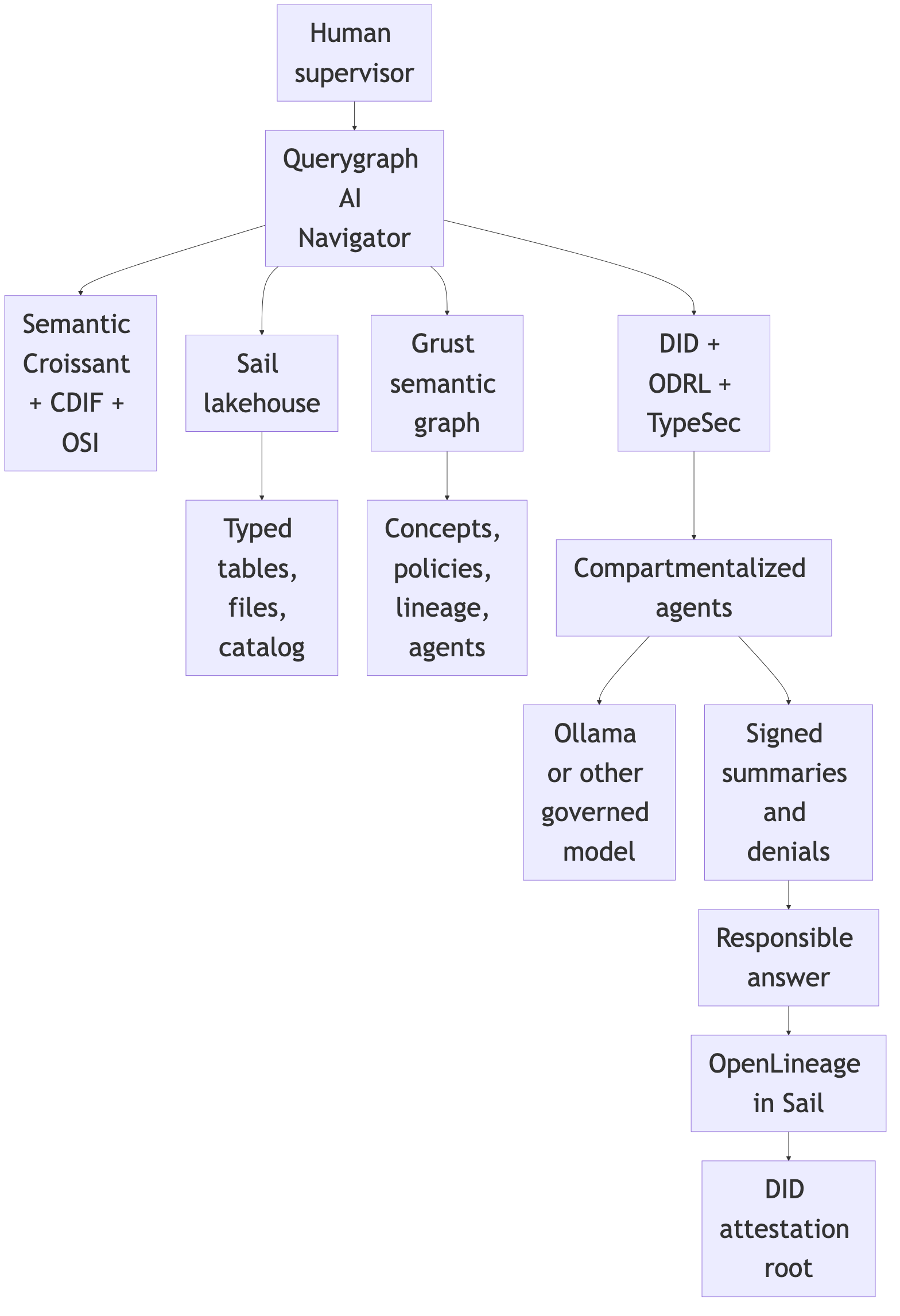
The layer that makes the substrate one system. Chapters 8–16 follow the Rust reference implementation; Chapter 17 covers the Python mirror. Everything in this part is exercised by the cross-language contract (Chapter 22).
MLCommons Croissant is the ML community’s standard for dataset
metadata: a JSON-LD document describing a dataset’s identity, license,
files (distribution), record sets, and fields, with
sameAs links from fields to shared semantic types. It is
how Hugging Face, Kaggle, and Google Dataset Search describe ML-ready
data — which makes it QueryGraph’s front door: a Croissant document is
both what QueryGraph emits for everything it loads and what it
accepts from outside (LakeCat bundles, public dataset
exports).
QueryGraph generates a Croissant sidecar per dataset, then treats its fields as the atoms of meaning: they become OSI column expressions (Chapter 12), ontology terms, and Grust graph nodes. From a real bundle:
{
"@type": "cr:Dataset",
"@id": "https://querygraph.ai/datasets/hazards/#dataset",
"name": "Hazard vocabulary",
"license": "https://creativecommons.org/licenses/by/4.0/",
"distribution": [{
"@type": "cr:FileObject",
"contentUrl": "https://querygraph.ai/datasets/hazards.csv",
"encodingFormat": "application/octet-stream"
}],
"recordSet": [{
"@type": "cr:RecordSet",
"field": [{
"@type": "cr:Field",
"name": "subject",
"dataType": "sc:Text",
"sameAs": "https://schema.org/about"
}, "…"]
}]
}The sameAs link is the semantic hook: it says this
column means something shared, not just something typed.
CODATA’s Cross-Domain Interoperability Framework covers the FAIR-metadata axes Croissant leaves out: discovery, access, rights, units, vocabularies, and profile declarations, expressed over the DCAT and Dublin Core vocabularies that data catalogs and national research infrastructures speak.
QueryGraph projects every dataset into a CDIF resource that declares which CDIF profiles it satisfies and how to reach the data — and carries the ODRL policy reference, so discovery metadata and rights metadata never separate:
{
"@type": "dcat:Dataset",
"dct:title": "Hazard vocabulary",
"cdif:profile": [
"https://cdif.codata.org/profile/discovery",
"https://cdif.codata.org/profile/manifest",
"https://cdif.codata.org/profile/data-description",
"https://cdif.codata.org/profile/data-access", "…"
],
"dcat:landingPage": "https://querygraph.ai/datasets/hazards",
"cdif:dataElement": ["…field descriptors…"],
"dct:accessRights": {"odrl:hasPolicy": "…/policy/default"}
}Croissant answers what is in the data; CDIF answers how
a stranger finds, evaluates, and accesses it. QueryGraph derives
the CDIF projection from the Croissant document
(CdifResource::from_croissant), so the two can never
disagree about the dataset they describe.
W3C Decentralized Identifiers give agents, services, and datasets stable identity without a registry. QueryGraph uses two DID methods, each earning its place:
did:oyd for deterministic agent and
dataset identity: the DID is derived from a seed by hashing, so the same
input always yields the same identifier — in Rust and Python, byte for
byte (a fixture in the equivalence suite pins
did:oyd:zQmciWcCbpq… for a known seed). Identity becomes
reproducible: re-run the pipeline, get the same actors.did:key for verification: Ed25519
public keys published as self-certifying identifiers
(did:key:z6Mk…) in envelope
verification_method fields, resolvable by anyone with no
infrastructure.A generated DID document, from a real bundle:
{
"@context": ["https://www.w3.org/ns/did/v1",
"https://w3id.org/security/suites/ed25519-2020/v1"],
"id": "did:oyd:zQmciWcCbpqbsYcNPVzdQ4YqznbAK9kRsnNRDdXg5Z73qCe",
"controller": "AI Navigator",
"public_key_multibase": "zFNru6TqKpt4ymk5pbCM5Bq4beqJ9nEDgLucfyv9nr98e",
"service_endpoint": "https://querygraph.ai/datasets/hazards"
}Textbook rule: DIDs say who is acting; ODRL says what is allowed; TypeSec turns the decision into a proof the code can carry.
The Open Digital Rights Language expresses machine-actionable policy:
permissions and prohibitions binding an action, an
assignee, and a target, each
optionally constrained. QueryGraph’s profile uses odrl:use,
odrl:read, odrl:derive, and two namespaced
actions — querygraph:translate and
querygraph:index. The evaluation rule is strict: an action
is allowed only if a permission matches the assignee and action and
no prohibition does.
A generated policy — note the shape of the default: the public may read with attribution, the navigator may index, and nobody may derive (train on) without a separate agreement:
{
"@type": "odrl:Policy",
"odrl:target": "https://querygraph.ai/datasets/hazards/#dataset",
"odrl:assigner": "did:oyd:zQmciWcCbpq…",
"odrl:permission": [
{"odrl:action": "odrl:read", "odrl:assignee": "public",
"odrl:constraint": "attribution required"},
{"odrl:action": "querygraph:index",
"odrl:assignee": "did:oyd:zQmciWcCbpq…",
"odrl:constraint": "local semantic indexing for AI Navigator"}
],
"odrl:prohibition": [
{"odrl:action": "odrl:derive", "odrl:assignee": "public",
"odrl:constraint": "no model training without separate agreement"}
]
}The four layers ship together as the Navigator
bundle — one JSON-LD document with @context for
all four vocabularies — built by the CLI (navigator), the
/v1 API, and the MCP tools, identically in both languages
(the equivalence suite asserts byte equality modulo timestamps):
querygraph navigator \
--dataset-name "Hazard vocabulary" \
--description "Controlled vocabulary with multilingual technical terms" \
--landing-page "https://querygraph.ai/datasets/hazards" \
--data-url "https://querygraph.ai/datasets/hazards.csv"
# → {"@type": "querygraph:AiNavigatorSemanticBundle",
# "layers": {"semanticCroissant": …, "cdif": …, "did": …, "odrl": …}}| Layer | Rust | Python |
|---|---|---|
| Croissant | CroissantDataset { files, record_sets, … },
Field::new(…).semantic_type(iri),
.to_json_ld() |
croissant.CroissantDataset,
Field(name, dtype, desc).semantic_type(iri),
.to_json_ld() |
| CDIF | CdifResource::from_croissant(dataset, landing, data_url),
.with_odrl_policy(id, json),
.to_json_ld() |
cdif.CdifResource — same constructors |
| DID | DidDocument::new_oyd(seed, controller),
.with_service_endpoint(url), .to_json() |
did.DidDocument.new_oyd(seed, controller) —
byte-identical output |
| ODRL | Policy { permissions, prohibitions },
Rule { action, assignee, constraint },
Action::{Use, Read, Derive, Translate, Index},
.allows(assignee, action), .to_json_ld() |
odrl.Policy / Rule / Action —
same evaluation rule |
| Bundle | AiNavigator::build(NavigatorInput) -> NavigatorOutput { croissant, cdif, did, odrl, bundle } |
AiNavigator().build(NavigatorInput(...)) |
The Open Semantic Interchange model is where business language meets governed columns. An OSI document carries one semantic model:
source (a
governed Sail table like
sail.qg_lakehouse.government_finance__countydata),
primary/unique keys, and fields;ANSI_SQL,
SAIL_SQL, SNOWFLAKE, MDX,
TABLEAU, DATABRICKS, and MAQL,
resolving a requested dialect with fallback to ANSI_SQL
then SAIL_SQL;ai_context on every level:
instructions, synonyms, and examples written for the LLM — the
model’s way of telling an agent how to use it.Croissant documents project into OSI mechanically: every recordSet
field becomes a governed SAIL_SQL column expression,
sameAs types become ontology terms, and a
row_count metric is attached. The projection is implemented
identically in Rust (OsiDocument::from_croissant_json,
behind POST /v1/models/import/croissant) and Python
(OsiDocument.from_croissant).
let croissant = serde_json::json!({
"name": "Energy Burden",
"description": "Demo energy fields",
"recordSet": [{"field": [{
"name": "monthly_cost",
"description": "Monthly household energy cost",
"sameAs": "https://querygraph.ai/ontology/monthlyEnergyCost",
}]}],
});
let osi = OsiDocument::from_croissant_json(&croissant, "qg_lakehouse")?;
assert_eq!(osi.semantic_model.name, "energy_burden_semantic_model");
assert_eq!(osi.semantic_model.datasets[0].source,
"sail.qg_lakehouse.energy_burden");from querygraph.osi import OsiDocument
osi = OsiDocument.from_croissant(dataset) # same projection rules
osi.semantic_model.resolve_metric("row_count") # 'COUNT(*)' via SAIL_SQL
osi.semantic_model.find_by_synonym("energy") # datasets/fields/metrics| Surface | Essentials |
|---|---|
OsiDocument |
from_mapping (accepts upstream
semantic_model: [] lists), from_yaml_file,
to_json; Rust adds
from_croissant_json(&value, schema) and
for_dataverse(&datasets); Python adds
from_croissant(dataset) |
OsiSemanticModel |
datasets, metrics,
relationships, ontology_terms,
ai_context; Python:
resolve_metric(name, dialect="SAIL_SQL") (fallback
ANSI_SQL → SAIL_SQL),
find_by_synonym(term) |
OsiAiContext |
instructions, synonyms,
examples; bare strings coerce to
instructions |
| Dialects | ANSI_SQL, SAIL_SQL,
SNOWFLAKE, MDX, TABLEAU,
DATABRICKS, MAQL |
QueryGraph’s access decision is deliberately redundant: RBAC and ODRL must both allow.
(resource, action) pairs.The two layers fail differently — a fat-fingered role grant does not
bypass a prohibition, and a permissive policy does not bypass a missing
role — and the combined decision is issued as an
AccessReceipt: principal, resource, action
IRI, the boolean, the reason, and the policy id. A denial is a receipt,
not an error: it flows through the same channels as an allow, gets
signed into the same envelopes, and appears in the same lineage.
from querygraph.odrl_rights import OdrlRightsLayer
decision = rights.decide(principal, "sail.qg_lakehouse.finance", Action.READ)
decision.allowed # rbac_allowed AND odrl_allowed
decision.receipt.reason # "RBAC and ODRL permitted action" / "… denied …"A real denial receipt, captured from a navigator-loop run (Chapter 21):
{
"principal": "did:example:qg-navigator",
"resource": "sail.qg_lakehouse.haalsi_baseline__restricted_raw",
"action": "odrl:read",
"allowed": false,
"reason": "RBAC or ODRL denied action",
"policy_id": "urn:querygraph:policy:navigator-demo"
}| Surface | Essentials |
|---|---|
RbacPolicy |
grants: [RoleGrant{principal, role}],
permissions: [RolePermission{role, resource, action}],
allows, roles_for; Rust adds
decide -> RbacDecision{matched_roles, …} |
Policy (ODRL) |
allows(assignee, action) — permission must match, no
prohibition may |
OdrlRightsLayer |
decide(principal, resource, action) -> OdrlDecision{rbac_allowed, odrl_allowed, allowed, receipt} |
AccessReceipt |
principal, resource, action
(IRI), allowed, reason,
policy_id, issued_at |
| MCP | check_access(principal, resource, action) returns the
full decision; denials are results |
Every governed run emits an OpenLineage event — the
open standard for data lineage that Marquez and the OpenLineage
ecosystem consume. QueryGraph’s events are COMPLETE run events carrying
a custom facet (queryGraph_typeDid) that binds the run to
the envelope that authorized it: protocol, conversation id, payload
hash, signature.
Conformance is proven, not asserted. The official 2-0-2 JSON Schema
is vendored in qg-python and validated with format checking on — a
discipline that immediately caught a real bug: the spec requires
run.runId to be a UUID, and both implementations were
emitting prefixed hashes. Both now derive run ids as
deterministic UUIDv5 values under a shared namespace
(uuid5(NAMESPACE_URL, "https://querygraph.ai/openlineage")),
from the same seeds as before; a fixture pins the cross-language
derivation, and the equivalence suite schema-validates the events both
CLIs emit.
Above the events sit attestations: the event’s
canonical hash is signed (Ed25519, did:key verification
method) into a LineageAttestation with a Merkle root, so an
auditor can verify that the lineage record is exactly the one the issuer
anchored. Events and attestations land in JSONL sinks and in Sail tables
(qg_audit) next to the data they describe.
# Python signs an envelope and writes it out…
uv run python - <<'PY'
import json
from querygraph.typedid import TypeDidAgent
env = TypeDidAgent.new("SupervisorAgent").request(
TypeDidAgent.new("FinanceAgent"),
action="summarize", resource="compartment:finance",
payload={"question": "Where is fiscal stress highest?"})
open("envelope.json", "w").write(env.model_dump_json())
PY
# …and the Rust CLI verifies it with no shared state:
cargo run -- verify-envelope --file envelope.json{
"payload_hash_valid": true,
"signed": true,
"signature_valid": true,
"verification_method": "did:key:z6MkrdhpoFnCtEGK3RhXqryfjxVpy…",
"scheme": "ed25519"
}Rust resolves the did:key, reconstructs the documented
signing payload (querygraph-typedid-signing-v1), and
recomputes Python’s canonical JSON byte-for-byte —
sort_keys, compact separators, ensure_ascii
escapes and all. Change one byte anywhere and
signature_valid flips to false with a non-zero
exit. The same check is served at
POST /v1/audit/verify-envelope and as the
verify_envelope MCP tool in both languages.
| Surface | Essentials |
|---|---|
OpenLineageRunEvent |
for_agent_run(request=envelope, job_name, inputs, outputs)
(Python) / for_dataverse_agent_run(…) (Rust);
event_hash() — canonical sha256 |
run_id_for(seed) |
deterministic UUIDv5 under
uuid5(NAMESPACE_URL, "https://querygraph.ai/openlineage") —
identical in both languages |
LineageAttestation |
from_event(issuer, subject, event_hash, signer=…),
verify(), signing_payload()
(querygraph-lineage-attestation-v1) |
| Validation (Python) | validation.validate_openlineage_schema(event) —
vendored official 2-0-2 schema, format-checked;
validate_croissant, validate_cdif,
validate_openlineage shape checks |
| Sinks | append_jsonl(path, event); Sail qg_audit
tables; Rust --openlineage-{file,url,sail} |
The data side of the reference implementation:
dataverse-e2e) takes live Dataverse datasets through the
whole chain — fetch, stage into Sail, project Croissant/CDIF/OSI, gate
with RBAC+ODRL, wrap the question in a TypeDID envelope, optionally
call Ollama through a DID-encrypted prompt-bound
gateway (--call-ollama), and emit lineage. The
--live-sail flag runs it against a real Sail server.querygraph lakehouse-register and
audit-register attach the loaded tables and the audit trail
to a PySpark session over Spark Connect.spark.sql("SELECT COUNT(*) FROM global_temp.government_finance__countydata")
spark.sql("SELECT event_hash, job_name FROM global_temp.openlineage_events")The stack’s canonical governed multi-agent narrative, implemented deterministically in both languages — the golden baseline the live loop is measured against:
CanReadDatasetCompartment,
CanDeriveRedactedSummary, …).CanAggregateSummaries), never the
compartments.Run it: cargo run -- qglake-story --json or
python -m querygraph qglake-story --pretty. The equivalence
suite asserts the two implementations agree on the governance semantics:
same roster, the broker (and only it) denied, attestation schemas
field-for-field identical.
| Surface | Essentials |
|---|---|
| Rust | run_qglake_story() -> QgLakeStoryReport (title,
question, supervisor, specialists, synthesis, rbac, policies,
semantic_catalog, typesec, open_lineage, did_attestation);
render_qglake_story(&report) for the readable
briefing |
| Python | qglake.build_python_qglake_story() -> dict (prompt,
agents, responses, synthesis, openlineage, attestation) |
| CLI | qglake-story --json (Rust) ·
qglake-story --pretty (Python); also
GET /v1/qglake/story and the run_qglake_story
MCP tool |
qg-python mirrors the same layers Pydantic-v2-first —
every model above is a BaseModel with the same field names
— and adds the ecosystem surfaces Python is for:
crypto extra): Ed25519
signing with seed-derived keys, did:key verification
methods, envelope and attestation verification. Without the extra,
digests are labeled unsigned:sha256: — never mistakable for
signatures.api_auth (Chapter 18’s client side).mcp extra) and A2A
card (Chapters 19–20).StructuredTool (sync and async), vendor-neutral
to_tool_schema().Install: pip install querygraph (core is pure Pydantic),
with extras crypto, mcp, agents,
validation, lakehouse, or all.
The package ships py.typed; the CLI mirrors the Rust
commands.
The division of labor: Rust loads and verifies the warehouse and serves the platform; Python gives notebooks, PySpark users, and agent frameworks a typed interop layer — and the two are held identical where they overlap (Chapter 22).
querygraph.crypto —
Ed25519Signer constructors and signing methods;
verify; public_key_from_did_key;
unsigned_digest; CRYPTO_AVAILABLE.querygraph.typedid —
TypeDidAgent construction, request, answer, signer, DID
key, and tool-schema methods; TypeDidEnvelope creation and
verification; AccessReceipt; GovernedPrompt;
AgentResponse; signing_payload_v1.querygraph.navigator_loop —
GovernedNavigatorLoop; answer;
demo; openai_compatible_llm.querygraph.api_auth —
mint_envelope_header; governed_post.querygraph.mcp_server —
create_server; serve;
demo_rights_layer; load_rights_layer;
parse_action.querygraph.a2a —
build_agent_card; SKILLS;
A2A_PROTOCOL_VERSION.querygraph.agents —
TypeDidLangChainToolAdapter sync and async invocation/tool
methods; to_tool_schema;
deterministic_specialist;
TypeDidAgentRun.aggregate.querygraph.lakehouse,
lineage, osi, croissant,
cdif, did, odrl,
odrl_rights, rbac, and validation
mirror the Rust layers from Chapters 8–15.Extras: crypto, mcp, agents,
validation, lakehouse, all; the
package ships py.typed.