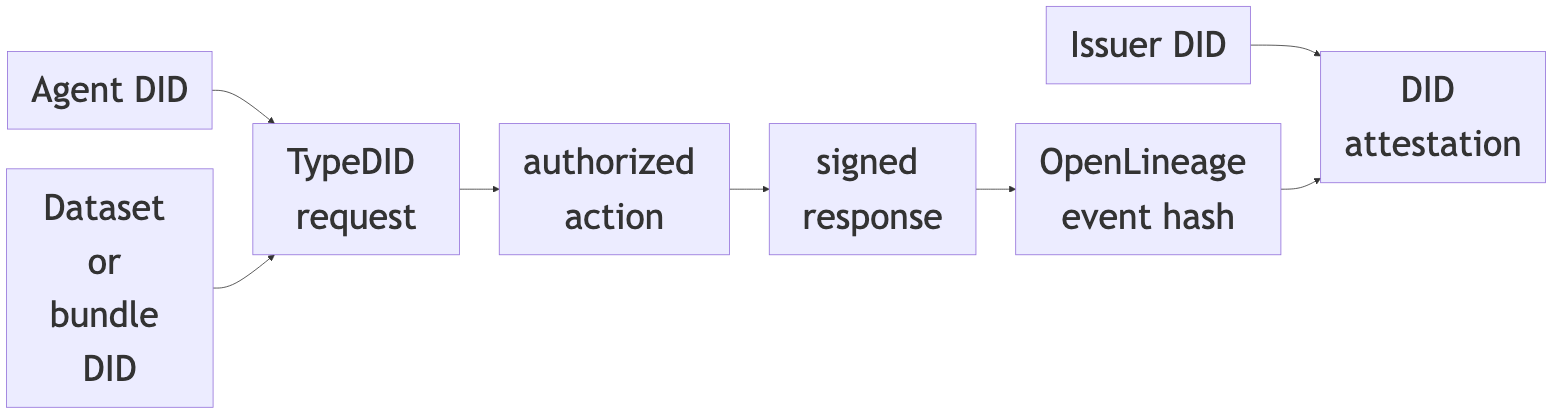
DIDs give Querygraph names that do not depend on a single database row or cloud account. In ordinary software, a user, job, dataset, or model run may be identified by whatever the local application happens to assign. In responsible agentic AI, that is too weak. The system needs identifiers that can be carried across messages, signatures, attestations, policies, and ledgers.
The first principle is portable accountability. An agent is not merely a process. It is an actor in a chain of delegation. A dataset is not merely a path. It is an object that can be cited, governed, signed, and audited. A model answer is not merely text. It is a claim made by an identified actor over an identified context. DIDs give those actors and objects stable handles.
This matters especially in local-first AI. A local system should not have to ask a central cloud service for permission to name its agents or sign its lineage. Deterministic local DIDs let demos and offline workflows preserve the same identity pattern that a production deployment can later anchor more strongly.
Querygraph uses DIDs for agents, bundles, issuers, and attestations.
The demo implementation in did.rs provides deterministic
local did:oyd documents so the examples can run without
external ceremony. TypeSec then lifts those identities into TypeDID
envelopes and typed capability checks.
The practical value appears when something goes wrong. Suppose a supervisor receives a summary that claims a climate-health pathway overlaps with an energy-burden cluster. Querygraph should be able to say which agent produced the claim, which DID identified that agent, which dataset DIDs or bundle DIDs were in scope, which issuer signed the lineage attestation, and which payload hash was signed. The DID is the thread that lets the answer be pulled back through the system.
The DID ledger is intentionally compact. Querygraph does not need to store every raw row or every full OpenLineage event in a DID ledger. The lakehouse is better for large queryable event bodies. The ledger should store roots, hashes, issuers, subjects, and signatures: enough to prove that the larger record has not been quietly rewritten.
Textbook rule: DIDs identify and attest; they do not replace the warehouse, the catalog, or the policy engine. Their job is to keep accountability portable across those systems.