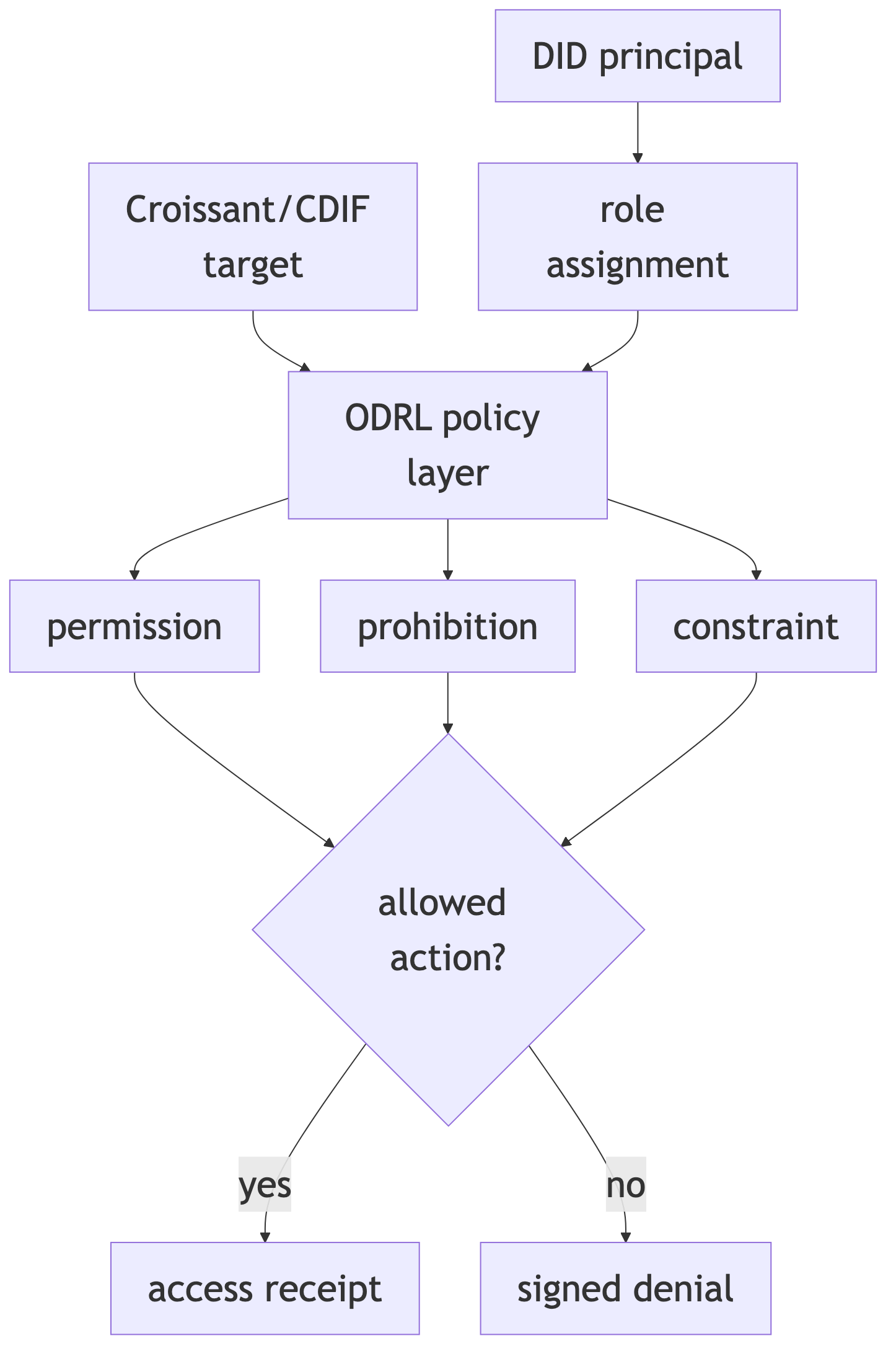
ODRL is the rights language in Querygraph. It is the place where permissions, prohibitions, duties, constraints, targets, assigners, and assignees become machine-actionable. Querygraph should not invent a second name for that layer. It should use ODRL clearly and then explain how RBAC, DIDs, TypeSec, and Sail surround it.
The first principle is that governance must happen before context assembly. Many AI systems retrieve first and redact later. That is backwards. If an agent is not allowed to read respondent-level health data, those rows should not enter its prompt, vector search, cache, or intermediate scratchpad. ODRL lets Querygraph express that rule as data rather than as a warning in a prompt.
ODRL also turns denial into an accountable event. A system that only logs successful access is incomplete. Querygraph records signed denials because a future reviewer needs to know not only what evidence was used, but also what evidence was correctly excluded.
The Rust implementation in odrl.rs models the part of
ODRL needed by the current demos: policy targets, permissions,
prohibitions, actions, assignees, and a simple allows
decision. That is intentionally small, but it preserves the key
discipline: an agent action is allowed only when the policy grants it
and does not prohibit it.
An ODRL policy should be able to say:
This chapter is where responsibility stops being a slogan. A responsible system must be able to deny access in a way that is as legible and auditable as approval. Querygraph treats ODRL denials as first-class outputs. They are signed, included in lineage, and passed to synthesis agents so the final answer knows which evidence was deliberately not used.
Textbook rule: ODRL is a pre-retrieval filter, not a post-answer apology. It shrinks the computational problem while making the ethical boundary explicit.