TypeSec is the security fabric that makes the policy layer programmable without making it squishy. Querygraph needs more than bearer tokens. Agents delegate to other agents. Prompts become operational artifacts. Model calls need bounded capabilities. Responses need signed provenance. A token that says “this process is authenticated” is not enough.
The first principle is typed authority. In ordinary API security, a service may receive a token and then decide what that token means inside application code. Agentic systems need something sharper. The system should know that this agent, in this conversation, may perform this action, over this resource, with this payload hash, under this policy. TypeSec gives Querygraph that shape.
This is a direct alternative to “trust the orchestrator.” A LangChain planner, an Ollama call, a local script, and a Rust service should all receive bounded capabilities rather than broad ambient authority. That keeps experimentation possible without letting every experiment become a privileged data channel.
TypeSec brings typed security to that world. In Querygraph,
agent.rs builds TypeDID request envelopes, access receipts,
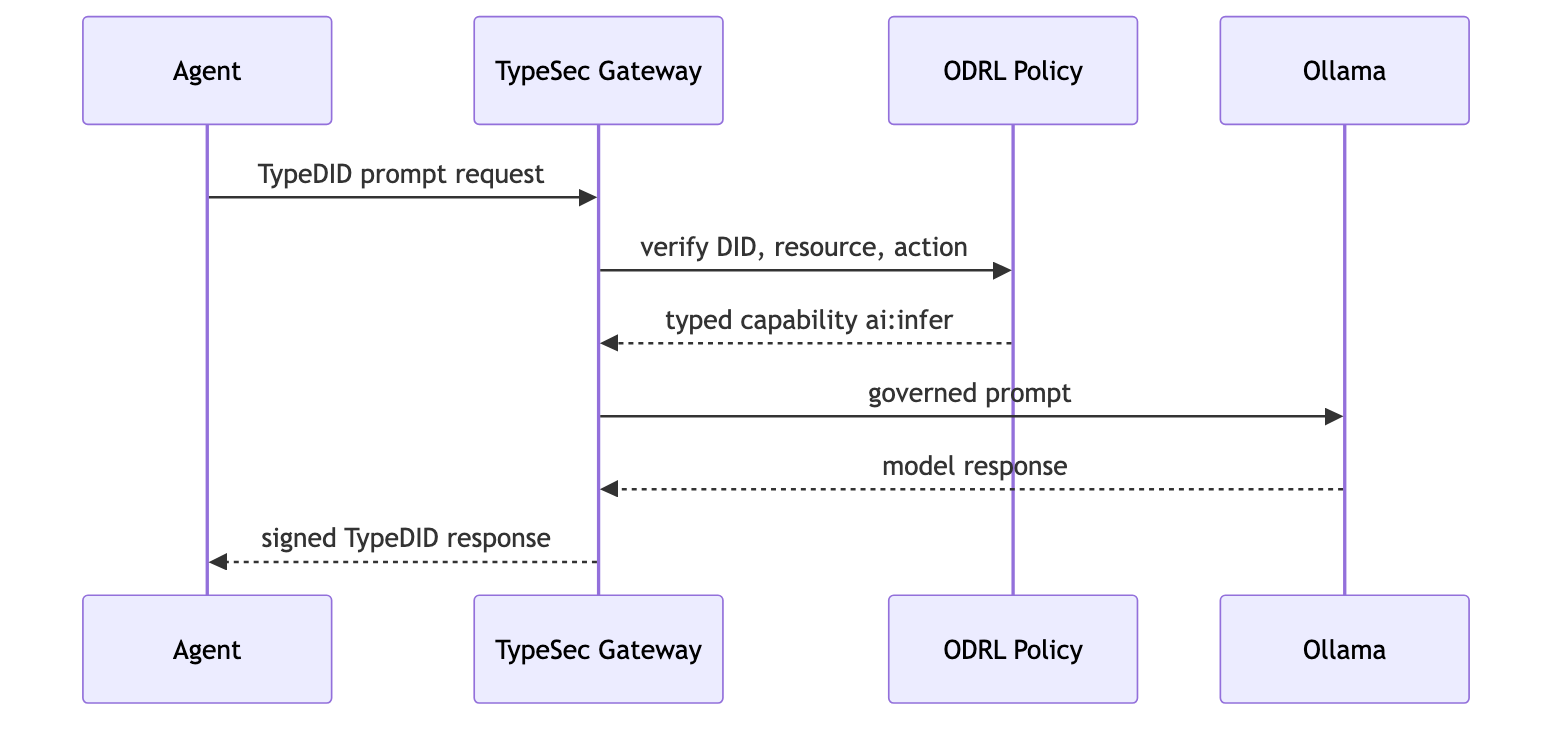
governed prompts, and signed responses. The TypeDID protocol gives each
agent interaction an identity-bound envelope. The policy decision can
then mint typed capabilities such as read,
summarize, derive, normalize, or
ai:infer for a specific resource and action.
The strongest example is the Ollama path. A local model is useful because it keeps inference close to the data. But local inference is still dangerous if the prompt is an ungoverned blob. Querygraph wraps the prompt in a TypeDID envelope, checks the resource and action, and sends only the governed prompt to the model. The response comes back as another signed artifact rather than a loose string.
This is where TypeSec and DIDs become more than identity plumbing. They let Querygraph preserve compartmentalization through an agent hierarchy. A synthesis agent can receive signed summaries from specialists without automatically receiving the raw permissions that produced those summaries.
Querygraph tracks TypeSec 0.13.1, “Torcello,” the fourth Venetian-landmark release after Murano and Burano. Burano is what made the cross-agent envelopes in the Ollama path trustworthy as evidence: each authorized interaction carries an audit-safe TypeDID attestation recording who did what to which resource, at which privacy level, without ever exposing the payload or the signing material. Torcello grows the same fabric into a security platform other agent stacks plug into — an interop plane that guards OpenAI, Anthropic, LangChain, and Pydantic-AI tool calls; a deny-by-default MCP gate; signed decision receipts with logging and replay; schema-validated tool bindings; and an OpenAI/Anthropic-compatible enforcement proxy.
Textbook rule: DIDs say who is acting; ODRL says what action is allowed; TypeSec turns that decision into a typed, signed capability that software can carry safely.