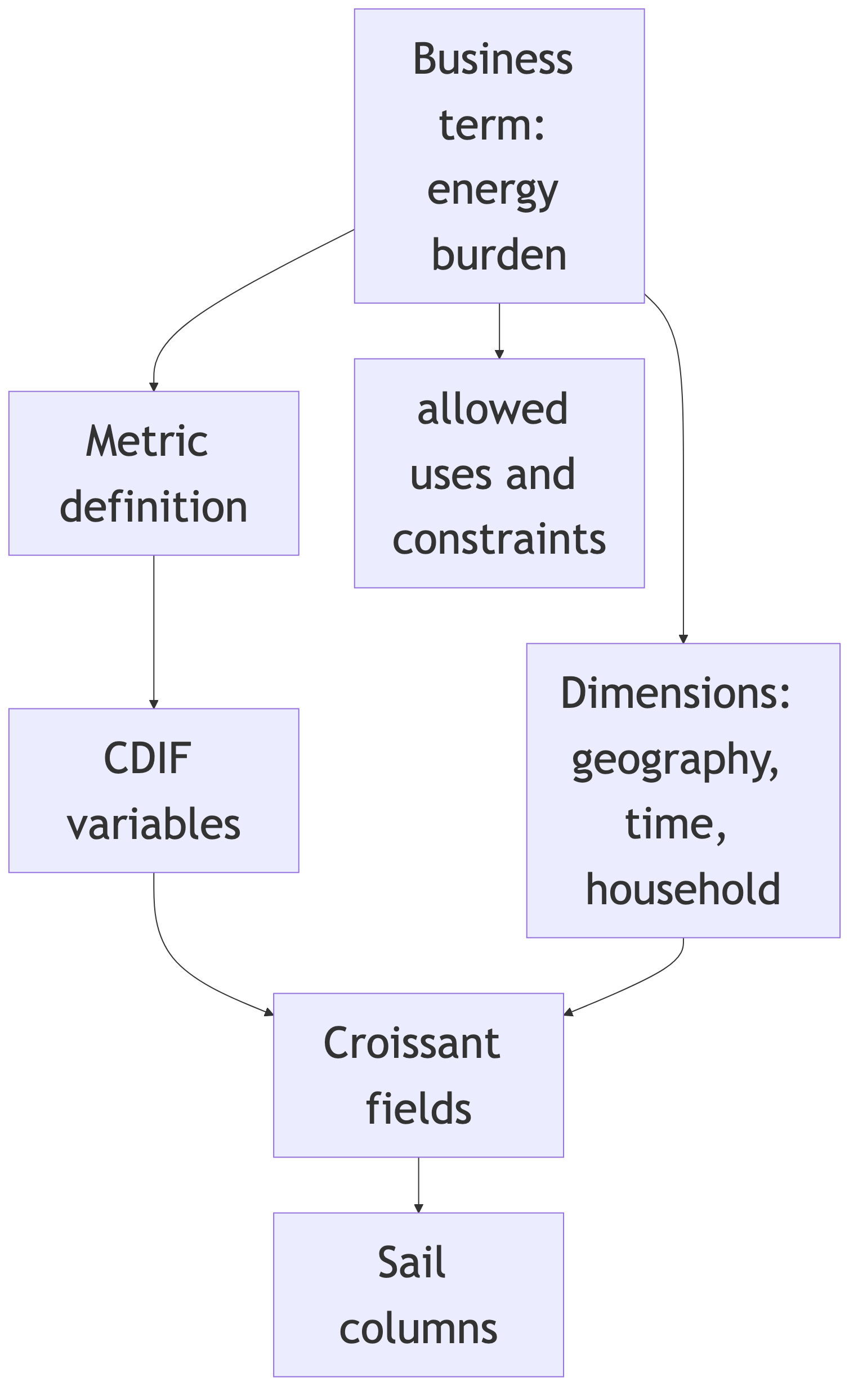
Open Semantic Interchange is the business-meaning layer. Croissant knows the shape of a dataset. CDIF knows how to publish it across ecosystems. OSI names the business concepts that make the dataset useful to an enterprise or public mission: metrics, dimensions, terms, relationships, and semantic models.
The first principle is that users ask business and scientific questions, not table questions. “Energy burden” is not a file format. “Fiscal capacity” is not a column type. “Mobility disruption” is not guaranteed to appear as a literal label. OSI gives those concepts a stable home so the navigator can map human intent onto executable data.
This is how Querygraph avoids the worst form of RAG: retrieving documents that sound related and hoping the model invents the right metric. With OSI, a term can point to dimensions, measures, expressions, fields, units, and allowed uses. The model can still help interpret the user question, but it is no longer solely responsible for defining the domain.
Without OSI, an AI Navigator can still find columns. With OSI, it can find the right concept. That distinction matters when users ask ordinary human questions. “Energy burden” may not be a column. It may be a concept composed from survey variables, household context, geography, unit conventions, and policy constraints. OSI gives Querygraph a place to model that concept instead of hoping a vector search finds a nearby phrase.
The Rust module osi.rs loads or synthesizes an OSI model
over datasets. In a small demo, the model can be generated from
Dataverse metadata. In a serious deployment, the OSI model should be
curated by domain experts and versioned like application code.
OSI is where ontology-driven AI becomes pleasant to use. Users should not need to know table names to ask precise questions. Agents should not need to infer business meaning from column labels alone. OSI provides the semantic bridge.
Textbook rule: OSI is the layer that turns local metadata into domain language. It is what lets focused retrieval start from a human question rather than a warehouse schema.