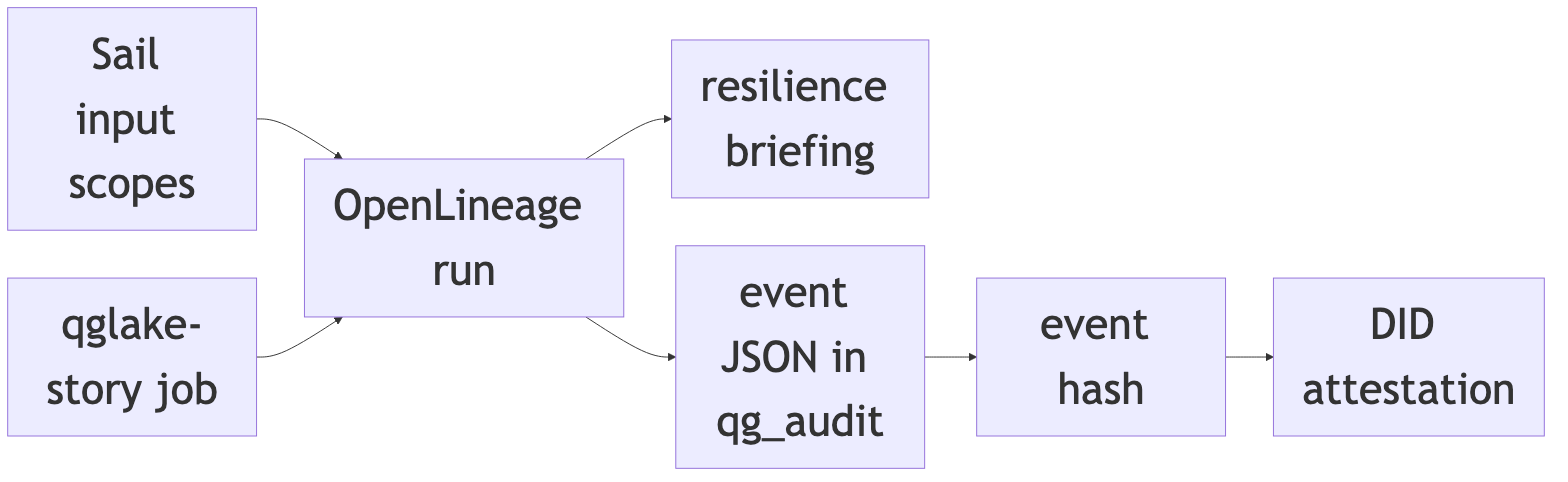
OpenLineage is the memory of what actually happened. Querygraph can generate beautiful metadata and enforce careful policies, but an operator still needs the operational story: which run executed, when it started, which job produced which output, which datasets were inputs, which facets described the run, and which event completed the derivation.
The first principle is reproducibility. A responsible answer is not only an answer that sounds right. It is an answer with a route behind it. If two runs produce different results, the operator should be able to compare data versions, prompts, model paths, policies, and input scopes. OpenLineage gives Querygraph an operational grammar for that comparison.
This is also a cost-control mechanism. Lineage lets the system reuse what is already known. If a dataset has been loaded, profiled, summarized, and attested, a future agent can inspect that history before recomputing. Stable history is one of the ways Querygraph avoids wasteful global recomputation.
The implementation in lineage.rs constructs OpenLineage
events, writes JSONL and HTTP sinks, writes Sail audit rows, and creates
TypeSec-backed DID attestations. The key design choice is that
OpenLineage belongs in Sail itself for the local lakehouse. The event
body is operational data. It should be queryable beside the tables and
metadata it describes.
When QG Lakehouse produces a resilience briefing, the lineage event records the input scopes for finance, energy, mobility, climate-health, reference data, and restricted metadata. The output is the briefing artifact. The DID attestation then signs a compact hash of that event. Auditors get both convenience and cryptographic accountability: query the full event in Sail, verify the root in the DID ledger.
This is reproducibility as a product feature. The answer is not just text. It is text with an execution trail.
Textbook rule: lineage makes context durable. Without lineage, every answer is a rumor; with lineage, an answer becomes an inspectable derivation.