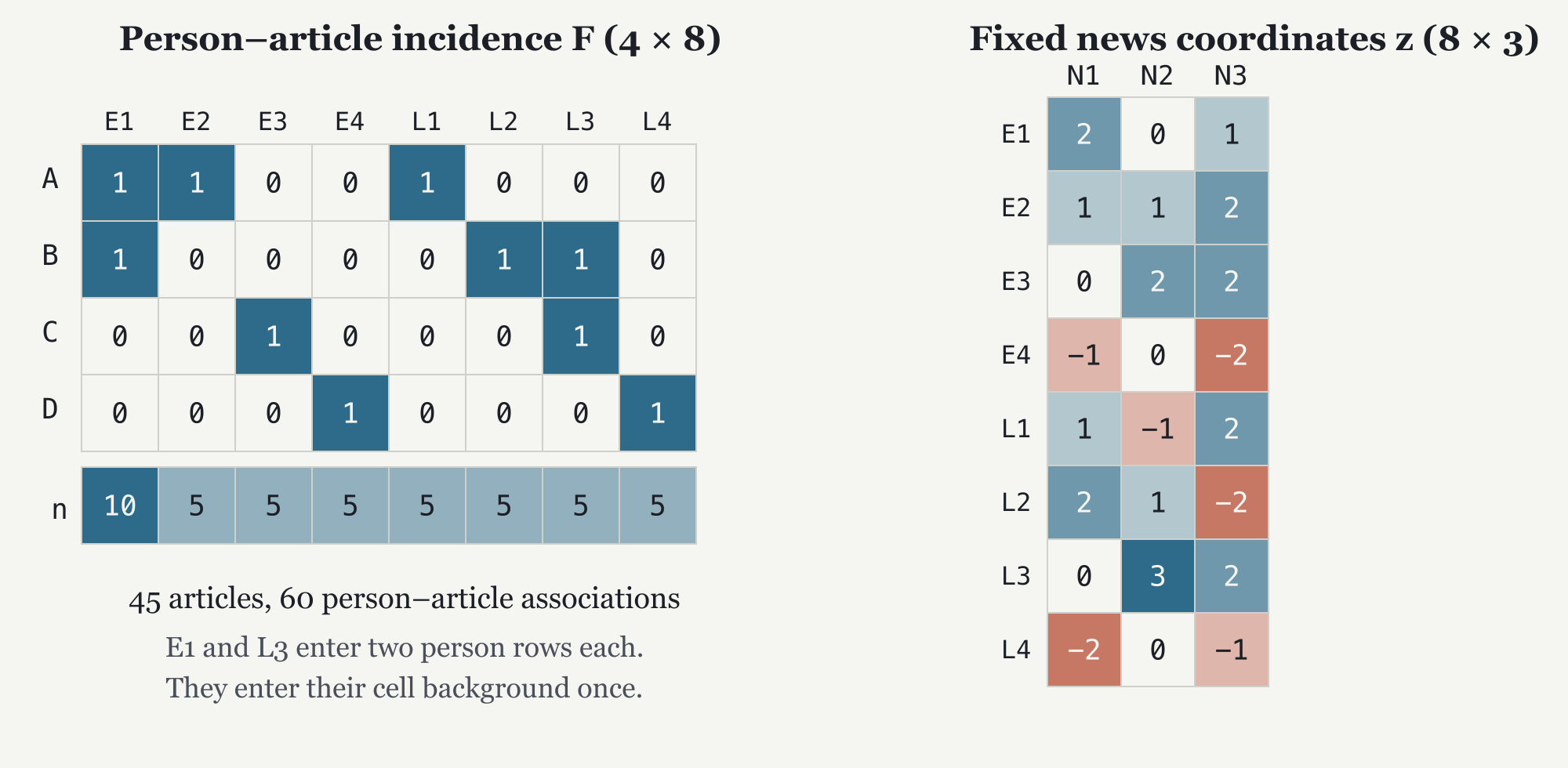
Our fictional example has people A, B, C, and D. The 45 distinct articles are grouped below only to save space: articles in a batch have identical toy coordinates and associations. They are distinct observations, not duplicate records to count repeatedly. E and L identify two source-and-decade cells. A cell specifies both the source and the decade; the letters do not imply that every early or late article belongs together.
The coordinates in the table are already standardized news coordinates . Their reference basis and scales are stipulated for this toy example, not estimated from the 45 rows.
| Batch | Cell | Distinct articles | N1 | N2 | N3 | Associated people |
|---|---|---|---|---|---|---|
| E1 | E | 10 | 2 | 0 | 1 | A, B |
| E2 | E | 5 | 1 | 1 | 2 | A |
| E3 | E | 5 | 0 | 2 | 2 | C |
| E4 | E | 5 | -1 | 0 | -2 | D |
| L1 | L | 5 | 1 | -1 | 2 | A |
| L2 | L | 5 | 2 | 1 | -2 | B |
| L3 | L | 5 | 0 | 3 | 2 | B, C |
| L4 | L | 5 | -2 | 0 | -1 | D |
There are 25 distinct articles in E and 20 in L. A has 20 associated articles, B has 20, and C and D have 10 each. Thus there are 60 person-article associations but only 45 unique articles. The ten E1 articles each name two people, as do the five L3 articles. This is why adding person counts is not a way to count the archive.
An incidence matrix records these associations. Its rows are people, its columns are articles, and an entry is 1 when the article is associated with the person and 0 otherwise. It is a bookkeeping device; it does not turn the association into a verified identity match or a social relationship. The figure compresses identical article columns into one column per batch, with its multiplicity shown below.
Let index a person and a source-and-decade cell. Let be the set of unique eligible background articles in cell , and its subset associated with person . For any set , denotes its number of members, called its cardinality. The notation means that article belongs to that set; a sum with that condition includes each member once. Recall that is article ’s standardized news-coordinate row. Let be the background mean and the person-cell mean, both rows. For nonempty article sets, divide the coordinate sums by their respective article counts:
The background is drawn from qualified candidate-associated articles, not from every article in the news corpus.
Write for the first coordinate of cell E’s background row. It is
Computing the other coordinates in the same way gives
Now consider A. Its 15 E articles have mean ; its five L articles have mean . Subtracting each cell’s background gives
The question has changed from “what is A’s coverage like?” to “how does A’s coverage differ from its available comparison coverage in each cell?” A negative coordinate means relatively less in that direction, not an absence of articles or disagreement with a topic.
For E, add each batch row multiplied by its distinct-article count. The coordinate sums are : N2 receives , while N3 receives . Divide all three sums by 25 to obtain . For L the sums are and the count is 20, giving .
A’s E numerator includes only E1 and E2: . Divide by 15 to obtain . Its L numerator is ; division by five returns . Subtract corresponding backgrounds one coordinate at a time. In E the first contrast is . The other two are and . These exact fractions explain the rounded contrast row above.
Each denominator counts the observations named by that numerator. The background counts unique eligible articles in a cell. The personal mean counts that person’s associated articles within that cell. Neither denominator counts the number of named people in the article.
A has three times as many articles in E as in L. If we pooled the articles, E would dominate. Let be the set of cells with enough articles for person ; counts retained cells. In production, a cell needs at least five articles associated with that person. For a nonempty retained-cell set, let be the balanced contrast row. The implemented aggregation computes it by averaging the supported cell contrasts equally:
In the toy example both cells qualify for every person. A’s average contrast is therefore
For comparison, weighting A’s two contrasts in the article-count ratio 15:5 would give . Neither averaging rule is a law of nature. They encode different questions. Equal supported-cell weighting prevents a densely covered cell from receiving greater weight merely because it contains more articles.
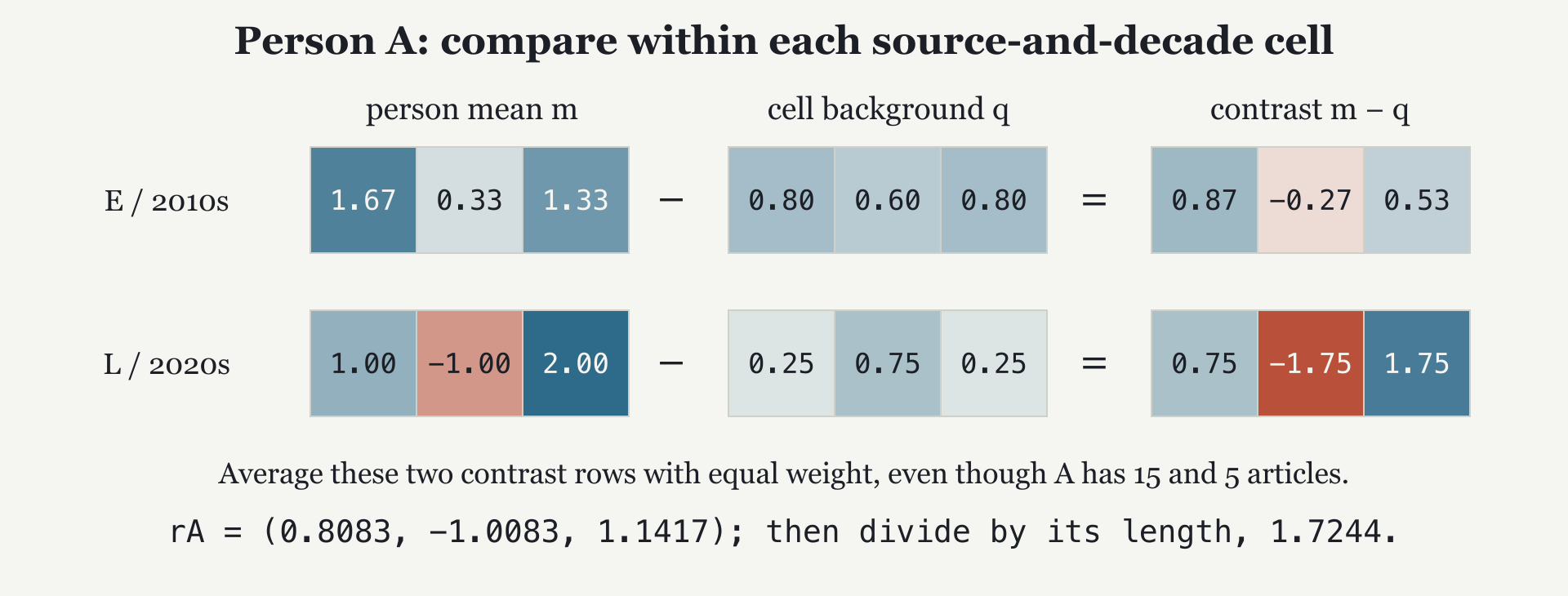
Equal cell weights are not necessarily equal source weights. A source spanning three supported decades contributes three cells, while another source spanning one contributes one. Nor does background subtraction remove every archive bias. It changes a specified comparison, within the selected coverage that is available.
The production gates require at least five articles in a person-cell and at least ten across the retained cells for a person-window. The contrast must also have nonzero numerical length. A cell with four articles is not quietly padded, and an unsupported profile is missing rather than a zero vector. These are operational support rules, not a proof of statistical reliability.
For A, the first balanced coordinate is . The other two are and . Thus the exact contrast is . A denominator of two gives one vote to each retained cell.
Article weighting gives E the weight and L the weight . Its first coordinate is . The difference comes from weights, not from any changed article coordinate.
The order of the support gates matters. Counts of six and four sum to ten, but the four-article cell is removed first. Only six retained articles remain, so that person-window fails. Counts of fifteen and four leave one retained cell with fifteen articles; its contrast alone supplies the average. Counts of fifteen and five retain both cells and twenty supporting articles. Missing means have no invented zeros. The notebook checks all three cases explicitly.
Let denote person ’s unit profile. For a nonzero contrast, normalize it as follows:
For A the result is approximately . Multiplying by a positive constant would produce the same . This makes directions comparable without turning article volume into profile length. It also discards magnitude. A small, unstable contrast can become a full-length unit vector, which is one reason to display support counts and eventually evaluate uncertainty rather than trusting the norm alone.
Let be the matrix formed by stacking those unit profiles. In the toy example its four rows, in person order A, B, C, D, are
Each row describes one person’s direction of relative coverage in the fixed news space. We have not yet learned a people pattern.
Check 4. Why would counting E1 once for A and once for B inside the background change the question? Why is it nevertheless correct for E1 to enter both individual profiles?
The exact balanced contrast has squared length
Its length is , approximately 1.72440. Dividing each entry by that length cancels the common denominator, so . Its squared coordinates add to .
This cancellation explains both the convenience and the loss. We can recover the direction from the normalized row, but we cannot determine whether the contrast originally had length 1.72440, twice that length, or half that length. Nor does the unit row remember that A had twenty supporting articles. Counts, magnitude, and article links must remain separate records.