The first row of the toy is . It tells us how N1 loads on P1 and P2. Starting from N1, the interface can rank people patterns by the absolute sizes of those two entries. P1 comes first, with a positive loading; P2 comes second, with a negative loading.
The first column of is . It tells us how P1 combines N1, N2, and N3. Starting from P1, the interface ranks news axes by the absolute sizes of these entries: N1, then N3, then N2.
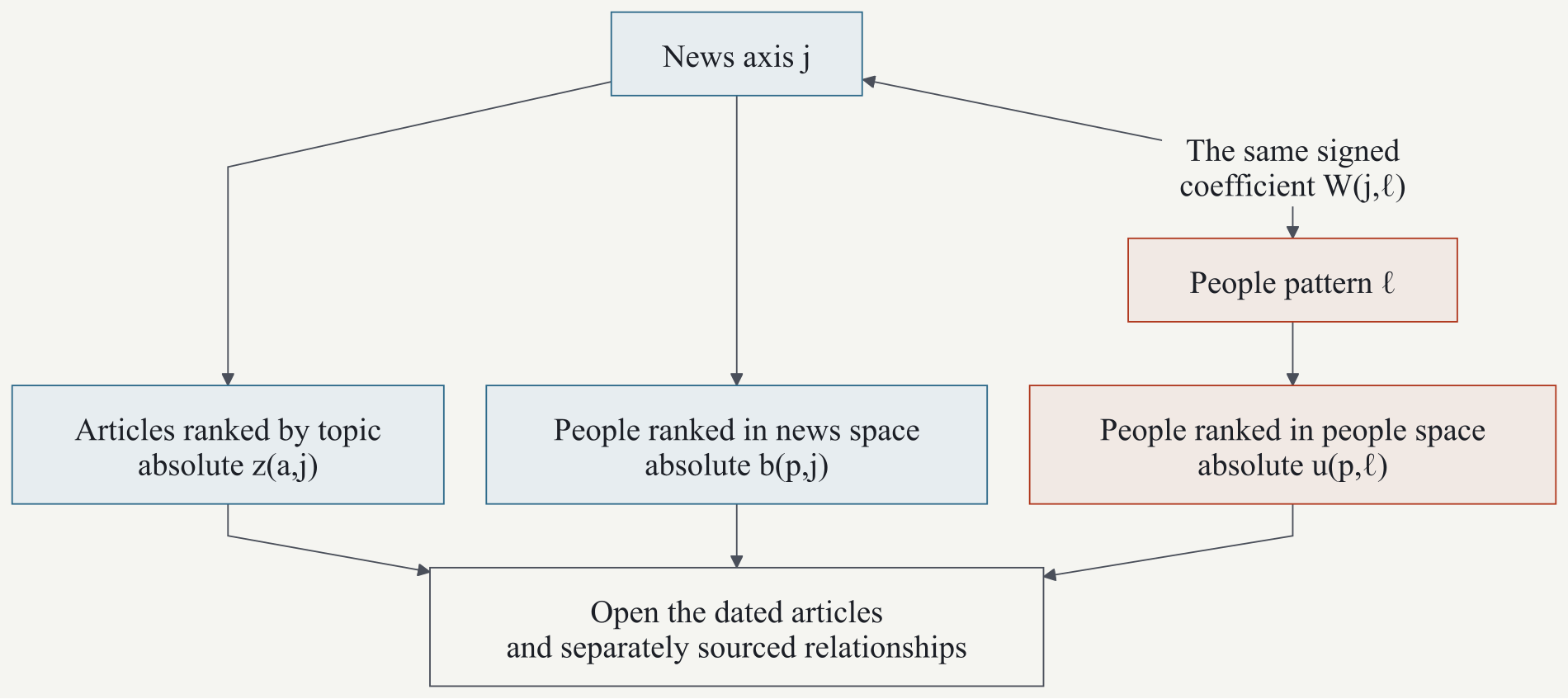
The coefficient linking N1 and P1 is exactly the same number in both views. No second model is needed to construct the reverse index. One index exposes rows of ; the other exposes columns.
For the diagram, let index news axes, retained people patterns, people, and articles. The scalar is row , column of ; and are coordinate of the article and person-profile rows; is coordinate of the people-score row. The diagram uses parentheses for these same indices: for example, means . Magnitude means absolute value, so either sign can produce a large magnitude.
This does not make ranks reciprocal. N3’s strongest loading is P1, but N3 is only the second strongest news loading of P1. Nor are the entries probabilities. Some are negative, and the absolute values in a row or column need not sum to one.
Starting from news axis N1, one can rank people by their direct profile coordinate . B comes first in the toy example, with 0.9484. This asks whose normalized relative coverage extends farthest along N1, considering either pole.
Starting from people pattern P1, one can instead rank people by . D comes first, with 1.1750. This asks whose centered profile extends farthest along that learned combination of news coordinates.
Those rankings differ because the questions differ. Neither is the same as finding the nearest neighbor of a selected person, which uses the entire row of people scores. A useful interface names the selected axis, mode, pole, model, and time window so a reader knows which question produced the list.
The audited Hacker News model supplies a real example. The loading
joining news axis N56 to people pattern P19 is
in both stored indexes. N56’s terms include develop,
interview, databas, ceo,
manag, and github. The shared coefficient is a
precise navigation fact. Calling it “the database CEO axis” would
discard the mixed meaning of the direction and the evidence needed to
identify a current CEO.
Check 5. In the toy matrix, N3 ranks P1 first. Where does P1 rank N3? Explain why the two answers are consistent.