A person can receive different coverage this year than ten years ago. We want to observe that movement without changing the ruler at the same time. Let index a coverage window, such as a decade or a recent period. Write for person ’s unit profile built from that window’s eligible articles, and for its people-coordinate row. A comma in separates the same indices without changing their meaning. Fit the people mean and loading matrix once on the all-history profiles, then use them for every supported window:
The article associations, supported cells, cell means, and cell backgrounds are recomputed for that window. Write for person ’s cell- mean in window , and for that cell’s background mean, both rows. They use the same averaging rule as before, restricted to articles in the window. The people mean and directions remain the fitted all-history reference.
This makes score differences interpretable within a model version. Let and be two supported windows for the same person, and let denote the Euclidean distance between that person’s two score rows. A simple movement statistic is
It is a distance between two supported coverage profiles. It is not, by itself, a measure of a person’s career change. A source mix can change, a name attribution can be corrected, or the comparison background can shift.
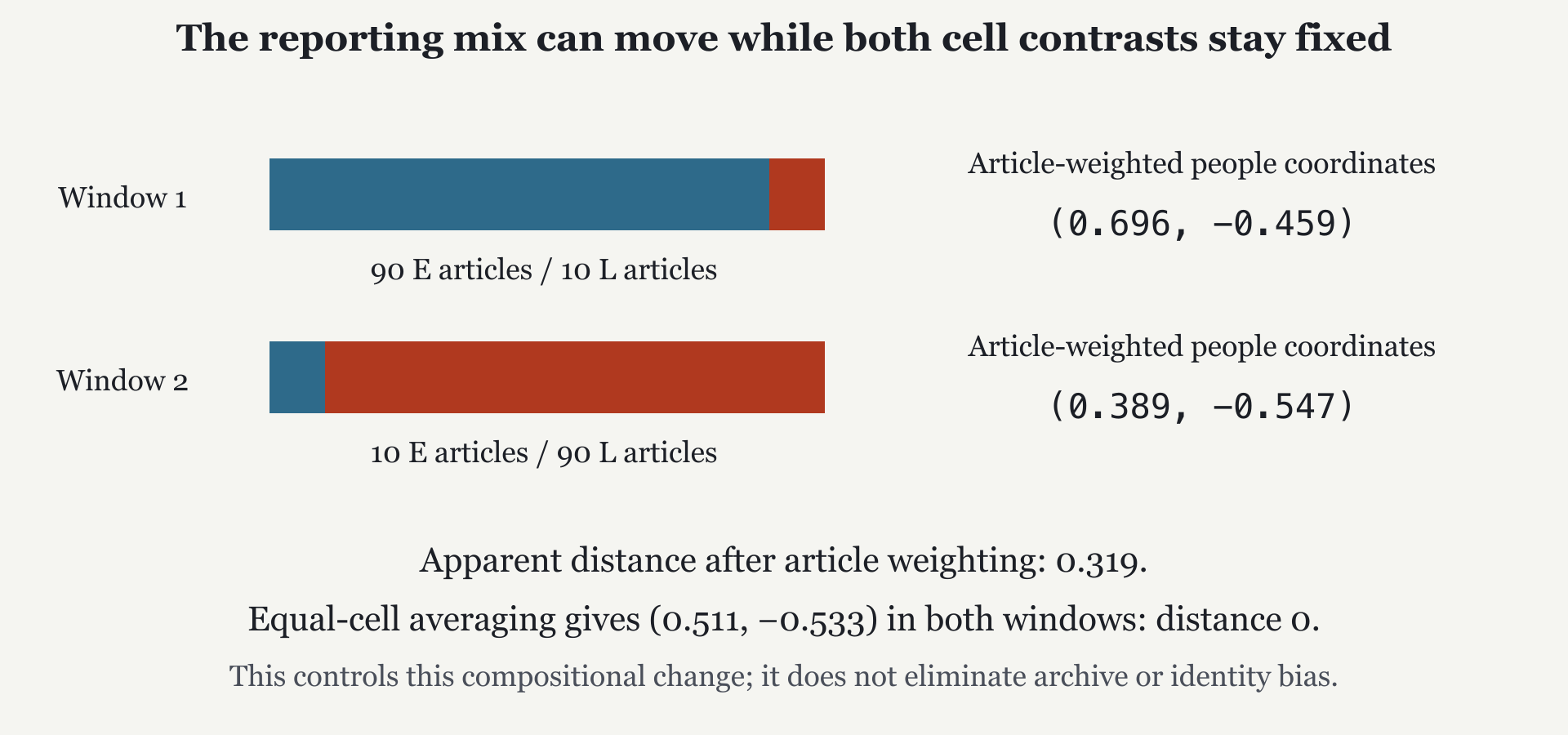
Return to A’s two cell contrasts. Hold both contrasts fixed, but consider two synthetic count mixtures: 90:10 and 10:90. These are a sensitivity experiment, not two additional observed periods in the 45-article corpus. In each mixture both cells satisfy the support threshold.
Weighting the contrasts by those counts, normalizing, and applying the same fitted mean and gives people scores of approximately in the first mixture and in the second. Their apparent movement is about 0.319. Yet neither cell-specific contrast changed.
Equal supported-cell weighting keeps A at its original people coordinates in both mixtures. This illustrates one composition effect the balancing rule can reduce; it does not establish invariance to changes in the actual within-cell article distributions.
It does not remove every composition effect. If a cell falls below the support threshold, the retained set changes. If changes, a person’s contrast changes even if its own articles do not. Two points can be drawn in one coordinate frame while still differing in their comparison backgrounds.
An article’s publication date is one clock. The newest matched article used in a historical profile is another. The valid date of a documented role is a third. A fourth piece of context, the model version, identifies the numerical ruler rather than a date of an event.
The projection watermark records the latest article date represented in the local projected corpus. In the frozen people snapshot, matched profiles end on 4 September 2026 and the local projection watermark is 5 September. The current-news overlay is dated 1 October. Recent-36-month and latest-90-day profile windows are anchored to the builder’s latest matched article date, not automatically to the reader’s present clock. Publishing a larger identity catalog on 2 October did not refit those profiles or update every watermark.
An absent recent profile means insufficient supported coverage. It must not be plotted at the origin as if it were evidence that the person became average.
For each person-cell-window, let count its distinct eligible associated articles, and let be the sum of their standardized rows . For , the previously defined person-cell mean is . These sums are unrelated to the singular-value matrix . Keep a separate deduplicated count and sum for the cell background. New qualified articles add to these statistics; expired rolling-window articles subtract from them; corrected attributions remove an old contribution and add the corrected one.
For these mean updates, the count and coordinate sum are sufficient summaries: they retain everything needed to recompute the mean without rereading unchanged articles. The Eigen Times streaming chapter explains this pattern more generally. The added complication here is the shared background: changing one background can require refreshing every person who uses that cell. Updating only the newly mentioned person would leave inconsistent comparisons.
After updating the means, reapply support gates, subtraction, equal-cell averaging, normalization, and the fixed projection. For one resulting supported window, abbreviate its centered profile as , suppressing the window index for this calculation. Let denote its discarded squared length; this scalar is distinct from the SVD’s right-direction matrix . Define the residual statistic as
It measures how much of that centered profile lies outside the retained people subspace. A sustained rise could motivate evaluating a new basis. It is not an automatic alarm that a person changed, and this uses people-profile geometry rather than silently inheriting every threshold from article-level Eigen Times statistics.
This refresh algorithm is proposed. The deployed latest-news overlay does not perform it. New versions should preserve their predecessors and be evaluated on later observations kept out of fitting, with adequate support and source-sensitive uncertainty checks before making claims about change.
Check 8. Can a person’s profile change when no new article has been associated with that person? Identify two ways the aggregation can produce that result.
Cell E’s unique background has count 25 and coordinate sum . Suppose one newly eligible article has row and is associated with an additional person outside the four fitted toy profiles. The background still consists of candidate-associated articles; none of A–D’s personal article sets changes. The count becomes 26 while the sum stays , so the background becomes , approximately .
Every existing profile using E now subtracts that new background. It can move despite having no newly associated article. Removing the same article restores the count to 25 and the original background exactly. A’s personal E sum is separately . Correcting one attribution by replacing with changes it to while leaving its count at 15. Addition, expiration, and attribution correction are different changes to the stored summaries.